
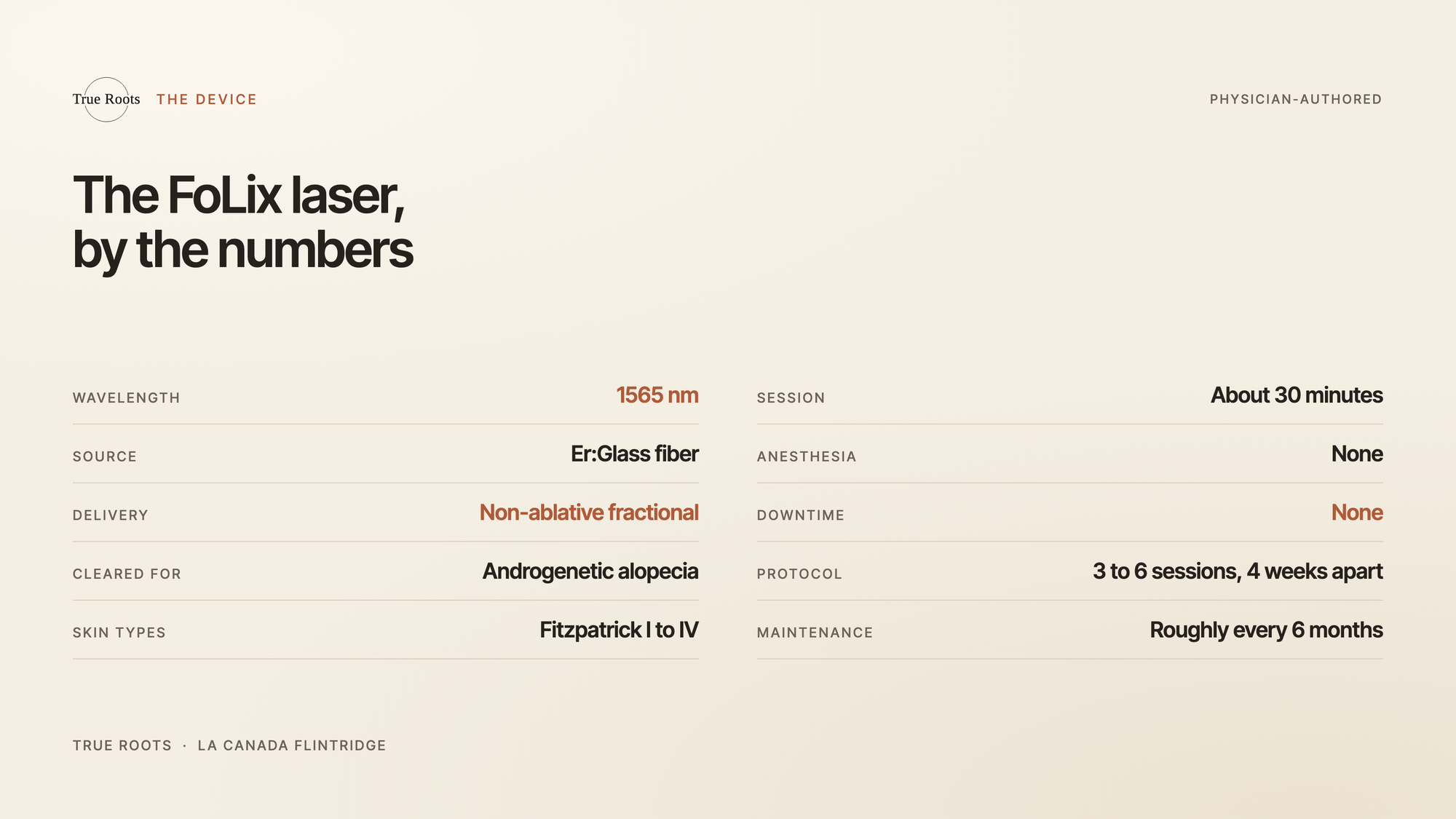
FoLix is a 1565 nm non-ablative fractional Er:Glass fiber laser from Lumenis, and the first fractional laser device the FDA cleared for hair loss. Every term in that sentence is a deliberate engineering decision. Together they let the device deposit controlled heat at follicle depth in the dermis without ever breaking the surface of the scalp.
Most clinics will tell you they use a laser. Very few will tell you what the machine actually does. Here is the engineering, in the order it matters.
Why does FoLix use a 1565 nm wavelength?
Because 1565 nm sits in the narrow band where water absorbs infrared light strongly enough to heat tissue, but not so strongly that the beam is spent in the first fraction of a millimeter. That balance is the whole design brief.
Compare the alternatives. An ablative CO2 laser at 10,600 nm is absorbed by water so aggressively that it vaporizes tissue at the surface. Hair removal lasers at 755 nm or 1064 nm chase melanin, which is precisely the wrong chromophore when the goal is to preserve a follicle rather than disable it.
At 1565 nm the primary target is tissue water, which is distributed throughout the dermis rather than concentrated in pigment. The energy travels past the epidermis and deposits where hair follicles are anchored, in the reticular dermis. Lumenis reports a treatment depth on the order of several hundred microns for the device. For the biology that follows, see how the FoLix laser regrows hair.
What does "fractional" actually mean?
Fractional means the laser does not treat the scalp as a continuous surface. It delivers an array of microscopic treatment columns, each a narrow shaft of coagulated tissue, and deliberately leaves untreated tissue standing between them.
Those untreated islands are the point. They keep the barrier function of the skin intact across most of the treated area, and they supply the reservoir of undamaged cells that repopulates each treated column during healing. A wound with healthy tissue on all four sides closes in days rather than weeks.
This is the same principle that made fractional lasers a turning point in skin resurfacing in the mid-2000s. FoLix applies it to the scalp, tuned for follicular depth rather than surface texture.
What does non-ablative buy you?
An intact stratum corneum, and everything that follows from it.
Ablative devices vaporize a column of tissue and leave an open microscopic channel. Non-ablative devices coagulate the tissue in place while the outer skin layer stays whole. Nothing is removed, nothing is open.
That single difference eliminates the infection route, the scabbing, the wound care instructions, and the recovery window. It is why a FoLix session ends with you putting on a hat and going back to your day rather than blocking off a week. The honest tradeoff is that non-ablative energy is gentler per pass, which is exactly why the protocol is a series of sessions rather than one aggressive treatment.
Why an Er:Glass fiber laser?
The source is an erbium-doped glass fiber. In a fiber laser the amplifying medium is the fiber itself: erbium ions embedded in glass, energized by diodes, with the light guided inside the fiber core along the full length of the gain medium.
That architecture matters for one reason above all others: beam quality. Because the light is confined by the fiber geometry rather than held in shape by an alignment of free-space mirrors, the output stays stable. Spot size, mode, and energy per pulse are repeatable pulse after pulse and session after session. Fiber also has a high surface-to-volume ratio, which makes waste heat easier to shed.
In a device whose job is depositing thousands of identical micro-columns across a scalp, dose consistency is not a luxury spec. It is the difference between an even treatment and a patchy one.
How do the algorithm and cooling keep it safe?
Two variables determine whether thermal energy in skin is therapeutic or damaging: how hot each zone gets (irradiance) and how much of the surface is treated (coverage). Lumenis states that FoLix controls both through a built-in algorithm, with continuous cooling of the skin surface during delivery.
The cooling creates a thermal gradient. The epidermis is held down while the dermis takes the heat, which protects the layer you want to preserve and treats the layer you want to stimulate. It is also why patients generally tolerate the session without numbing cream.
Automating irradiance and coverage narrows the range of operator variability. It does not remove the physician from the process. Candidacy, staging, and the underlying cause still have to be assessed, which is covered in who is a good candidate for FoLix and FoLix side effects and safety.
Why is the clearance limited to Fitzpatrick skin types I to IV?
Because melanin still competes for the beam, even at a water-targeting wavelength. Absorption by melanin at 1565 nm is low, but it is not zero. In more melanin-rich skin a larger share of the incoming energy is taken up in the epidermis before it reaches the dermis, which raises epidermal temperature and with it the risk of pigment change.
The FDA cleared FoLix to improve the appearance of scalp hair in adult men and women with androgenetic alopecia, Fitzpatrick skin types I to IV. That boundary reflects the population the device was studied in and cleared for. We treat within the cleared indication.
What does all that engineering buy the patient?
Thirty minutes, no needles, no anesthesia, no drug, and no downtime.
| Specification | FoLix |
|---|---|
| Wavelength | 1565 nm (near-infrared) |
| Laser type | Er:Glass fiber, fractional |
| Ablative | No. Non-ablative, skin surface stays intact |
| Cleared indication | Improving the appearance of scalp hair in adult men and women with androgenetic alopecia |
| Skin types | Fitzpatrick I to IV |
| Session length | About 30 minutes |
| Downtime | None. Normal activity immediately |
| Protocol | 3 to 6 sessions, about 4 weeks apart |
| Maintenance | Roughly every 6 months |
As for whether the engineering translates: a 2025 study published in Lasers in Surgery and Medicine by Avram, Queen, Shapiro, and Munavalli, with authors affiliated to Weill Cornell, Columbia, NYU, and Wake Forest, reported improvement in the appearance of scalp hair along with measured increases in hair count and follicular units per square centimeter at one-month and three-month follow-ups compared with baseline. Results vary from person to person. For what that looks like month by month, see the FoLix results timeline.
At True Roots Performance & Aesthetics in La Canada Flintridge, FoLix is delivered under board-certified physician Dr. Luis Valle, who evaluates the scalp and the underlying labs before anyone is put on a plan. Patients come from La Canada Flintridge, Pasadena, Glendale, and across greater Los Angeles for hair restoration in La Canada Flintridge.
This article is educational and not a substitute for personalized medical advice.