
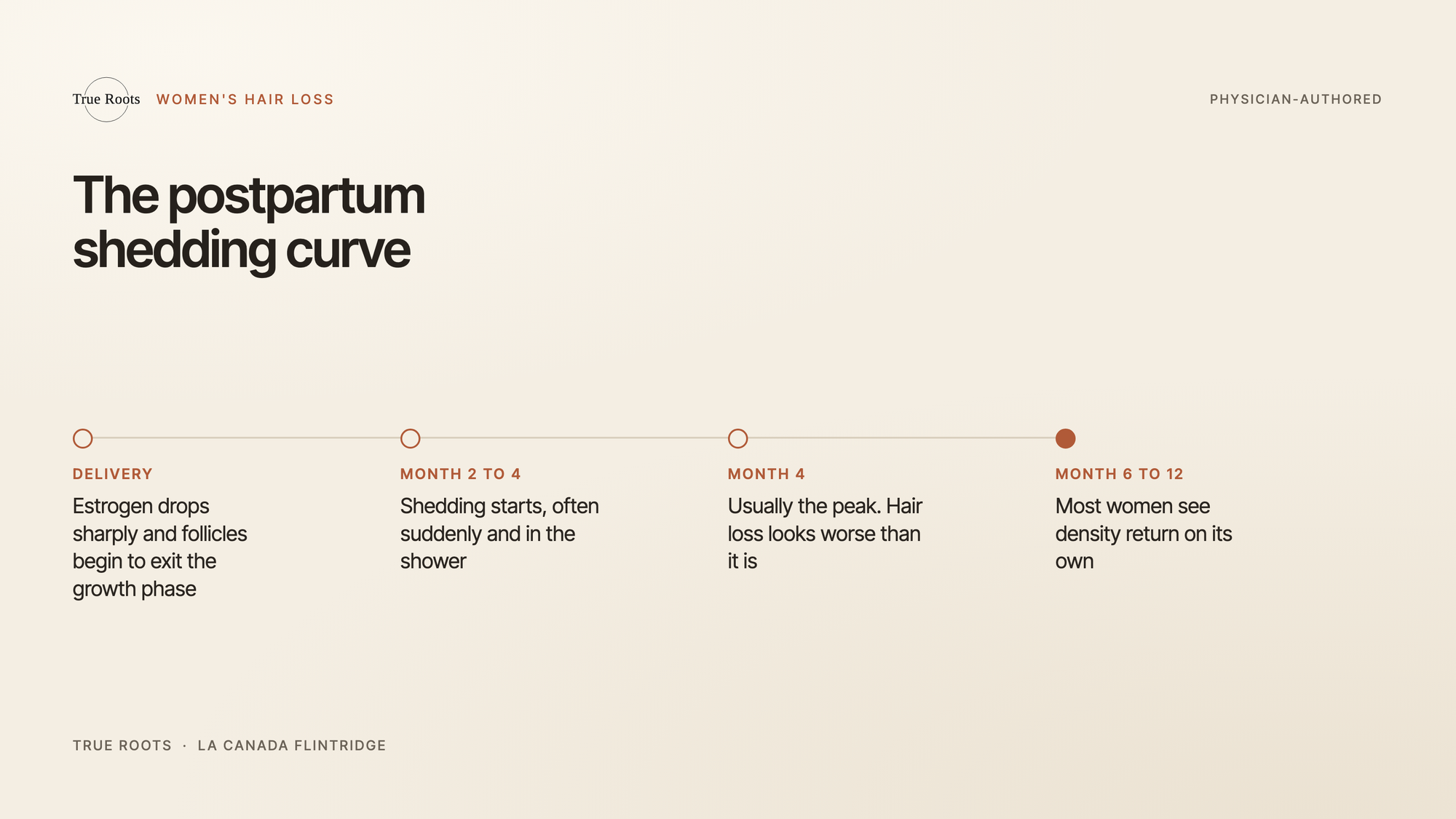
Postpartum hair loss is a temporary shedding phase called telogen effluvium, triggered by the sharp estrogen drop after delivery. It usually begins two to four months postpartum, peaks around month four, and resolves on its own by six to twelve months. The follicles are not damaged, so density typically returns without treatment. Timing varies from woman to woman.
Why does hair fall out after having a baby?
During pregnancy, high estrogen keeps far more hairs than usual locked in the growth (anagen) phase. That is why hair often looks and feels thicker at thirty weeks than it ever has.
After delivery, estrogen falls quickly, and all of those extended hairs shift into the resting (telogen) phase at roughly the same time. Two to three months later they release together.
That synchronized release is what you are seeing in the shower drain. The clinical name is telogen effluvium, and the important part is that the follicle stays intact. Nothing has been destroyed.
When does postpartum shedding start, peak, and stop?
Shedding usually begins around two to four months after delivery and peaks near the four month mark, then tapers over the months that follow. Most women are back to a normal shedding rate somewhere between six and twelve months postpartum.
Regrowth can look alarming before it looks good. Short, wispy, sometimes upright hairs along the hairline and part are new hairs coming in, not more loss.
Breastfeeding does not cause the shed. Weaning is its own hormonal shift, though, and some women notice a second, milder round of shedding around that transition.
How much shedding is normal after birth?
A typical scalp releases somewhere in the range of fifty to a hundred hairs a day. In a postpartum telogen effluvium, that number can climb several times higher for a period of weeks.
The clues that matter more than the count: is it diffuse across the whole scalp (expected) or concentrated in one patch (not expected), and is it slowing down by month six?
| Time since delivery | Expected | Worth getting checked |
|---|---|---|
| 0 to 2 months | Little or no change in shedding | Heavy shedding this early |
| 2 to 4 months | Shedding ramps up, diffuse, peaks near month 4 | Patchy loss, scalp pain, burning, or scaling |
| 4 to 8 months | Shedding tapers, wispy regrowth appears at hairline | Shedding still increasing, or heavy fatigue and cold intolerance |
| 8 to 12 months | Density visibly recovering toward baseline | No regrowth at all, or a part line that keeps widening |
| Past 12 months | Back to normal shedding | Ongoing shed, or thinning concentrated on the crown |
When is it not just postpartum shedding?
Three things hide comfortably behind the phrase "it is just postpartum."
Iron depletion. Blood loss at delivery, the demands of pregnancy, and breastfeeding can all pull ferritin down. Low iron stores prolong a shed and blunt the recovery, and it is one of the easiest contributors to correct.
Thyroid changes. Postpartum thyroiditis is genuinely common, commonly cited at around five percent of women in the first year after birth, and it can swing from overactive to underactive before settling. Fatigue, temperature intolerance, mood changes, or heart rate changes alongside the shedding are reasons to test rather than wait.
Unmasked pattern loss. A postpartum shed can reveal underlying female pattern hair loss that was already in progress. That component does not resolve on its own. The tell is a part line that keeps widening and thinning concentrated at the crown, rather than diffuse shedding that slows down.
This is what hair loss blood work is for: ferritin, a complete blood count, thyroid function, vitamin D, and B12 answer most of the question in one draw.
What actually helps postpartum hair loss?
Time does most of the work, but a few things genuinely move the needle.
Correct what the labs find. Iron and thyroid are the two that most often change the trajectory, and both are treated by a physician rather than guessed at with a supplement.
Eat enough. Postpartum life makes it easy to under-eat protein and calories, and hair is the first non-essential tissue the body deprioritizes.
Handle the hair gently. Tight ponytails and buns pull on an already fragile hairline, and traction damage at the temples is avoidable.
Be careful with medications. Minoxidil is a standard tool for persistent thinning, but its use while breastfeeding is a conversation to have with your physician first, not a decision to make from a product label.
Is FoLix the right treatment for postpartum shedding?
Usually not, and we would rather say so than sell you a package you do not need.
FoLix is a 1565 nm non-ablative fractional laser, FDA-cleared to improve the appearance of scalp hair in adults with androgenetic alopecia. Postpartum shedding is a different problem: it is self-limiting, and in most women it corrects itself. Treating it with a device would take credit for a recovery that was going to happen anyway. FoLix is also not recommended during pregnancy or nursing.
Where FoLix does become relevant is the second scenario above. If you are a year out, the shedding has stopped, and the density never came back, what is left is usually pattern thinning. That is exactly what FoLix for women is designed for, and it works best in the early to middle stages while living follicles remain. Results vary. If your thinning is tracking with a broader hormonal shift instead, menopausal hair thinning covers that path.
Getting evaluated in La Canada Flintridge
True Roots Performance & Aesthetics is in La Canada Flintridge, serving Pasadena, Glendale, and the greater Los Angeles area. Hair restoration here is physician-led by Dr. Luis Valle, a board-certified physician, which in practice means the first visit is a diagnosis rather than a sales pitch: scalp exam, history, and targeted labs to separate a temporary postpartum shed from something that needs treating.
This article is educational and not a substitute for personalized medical advice.