
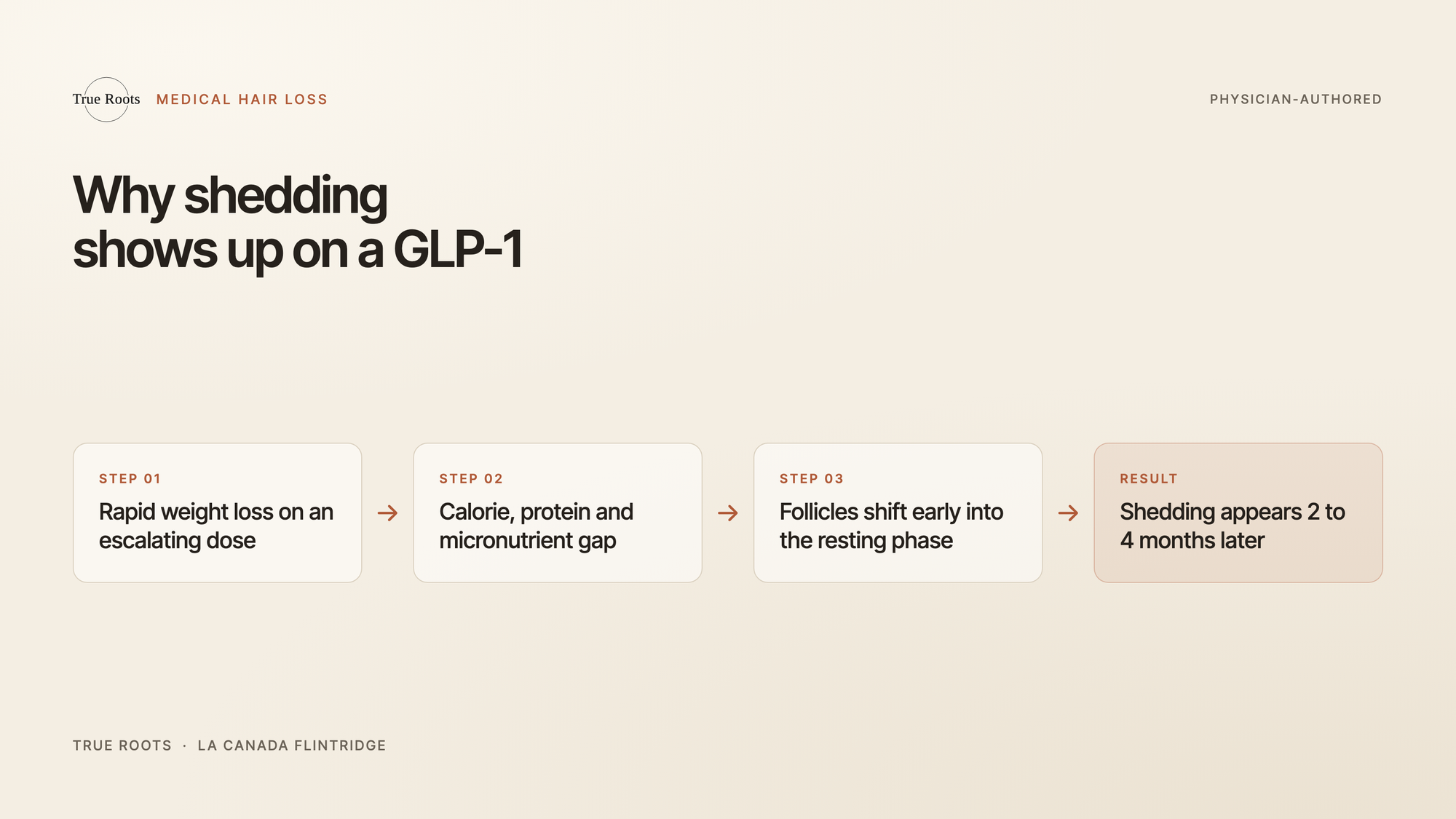
Hair shedding on GLP-1 medications is real, and it is usually telogen effluvium caused by the speed of weight loss and the nutritional gap that comes with it rather than direct follicle damage. It is non-scarring, so the follicle stays intact and regrowth is expected. Slowing the rate of loss and correcting deficiencies is the fix. Individual responses vary.
Does Ozempic actually cause hair loss?
The association is documented. A 2026 BMJ study found roughly a 37 to 68 percent higher risk of an alopecia diagnosis in patients on semaglutide or tirzepatide compared with patients on other diabetes medications. GLP-1 labeling now lists alopecia.
The absolute numbers matter as much as the relative ones. In that study, alopecia diagnoses occurred at about 7 per 1,000 patient-years on the GLP-1 medications versus roughly 4 to 5 per 1,000 patient-years in the comparison group.
Two details in the data point straight at the mechanism. Risk tracked with the higher doses used for obesity treatment, not the lower doses used for diabetes, and it tracked with faster weight loss. That pattern describes a consequence of rapid loss, not a drug that attacks follicles.
Why rapid weight loss triggers shedding
Hair is metabolically expensive and biologically optional. When the body detects a sharp energy deficit, it deprioritizes hair before almost anything else.
A large calorie deficit pushes an abnormal number of follicles out of the growth phase and into the resting phase at once. Those hairs sit there for roughly two to three months, then release together. That delay is why the shedding shows up long after you started the medication and often after you were pleased with your results.
The clinical name is telogen effluvium, and it is the same mechanism behind shedding after surgery, illness, or a crash diet. The follicle is not scarred, so it can recycle back into growth.
There is usually a second contributor: appetite suppression works, which means intake drops in protein, iron, zinc, and B vitamins right when the body needs them for tissue turnover.
Is this shedding or is it pattern hair loss?
The distinction changes what you do next, and both can be happening at once.
| GLP-1 telogen effluvium | Pattern hair loss | |
|---|---|---|
| Onset | 2 to 4 months after fast loss begins | Gradual, over years |
| What you notice | Heavy shedding in the shower and brush | Loss of density, widening part, receding temples |
| Distribution | Diffuse across the whole scalp | Crown, part, or hairline specifically |
| Course | Self-limiting once the trigger is fixed | Progressive without treatment |
| Regrows on its own | Usually | No |
A rapid weight loss shed can also unmask androgenetic alopecia that was already quietly underway. When the temporary shedding stops and the density still has not come back after six to twelve months, that is what is left, and it needs its own plan.
The practical playbook
Five things, in order of impact.
Slow the rate of loss. This is the lever with the most leverage and the one most people skip. Aggressive weekly loss is what correlates with shedding in the data. A slower trajectory to the same destination protects hair, lean mass, and adherence.
Hold protein high. A commonly used target is roughly 1.2 to 1.6 grams of protein per kilogram of body weight daily, higher than most people manage on a suppressed appetite. Confirm the right number for you with your physician, since kidney function and other conditions change it.
Run the labs, then correct what is low. Ferritin, vitamin D, B12, zinc, and a full thyroid panel. These are the deficiencies that turn a short shed into a long one, and they are all correctable. See hair loss blood tests for what a complete panel covers.
Reassess dose escalation. Titration schedules are a starting template, not a mandate. If shedding starts, holding a dose longer before stepping up is a legitimate clinical option to discuss.
Give it time. Once the trigger is addressed, regrowth generally takes several months, and it arrives as short, fine hairs before it looks like density.
What a physician-led program does differently
This is the part that separates a real weight loss program from a prescription refill.
A physician-led program measures body composition rather than scale weight alone, sets a target rate of loss instead of maximizing it, checks the labs above before and during treatment, and adjusts the dose when a side effect like shedding appears. A prescription arriving in the mail on a fixed titration schedule does none of that, because nobody is watching the inputs.
That is how our weight loss and peptide program is structured, under Dr. Luis Valle, and it is the reason physician-led care matters more here than it does for a cosmetic service.
If the density does not come back
Give the shed its window. If you are six to twelve months past the peak, the shedding has settled, and your part is still wider than it was, you are likely looking at pattern thinning rather than residual effluvium.
That is a different problem with different tools: minoxidil, and for those who prefer a drug-free option, FoLix, a 1565 nm non-ablative fractional laser FDA-cleared to improve the appearance of scalp hair in adults with androgenetic alopecia. Sessions run about thirty minutes with no needles and no downtime, on a protocol of three to six sessions about four weeks apart, then maintenance roughly every six months. Results generally begin around eight to twelve weeks and continue through three to six months. Results vary.
Where to get this evaluated
True Roots Performance & Aesthetics is in La Canada Flintridge, serving Pasadena, Glendale, and greater Los Angeles. Weight management, hormone optimization, and hair restoration are all physician-led here by Dr. Luis Valle, a board-certified physician, which means the shedding and the medication driving it get addressed by the same person in the same visit rather than in two separate ones.
This article is educational and not a substitute for personalized medical advice.