
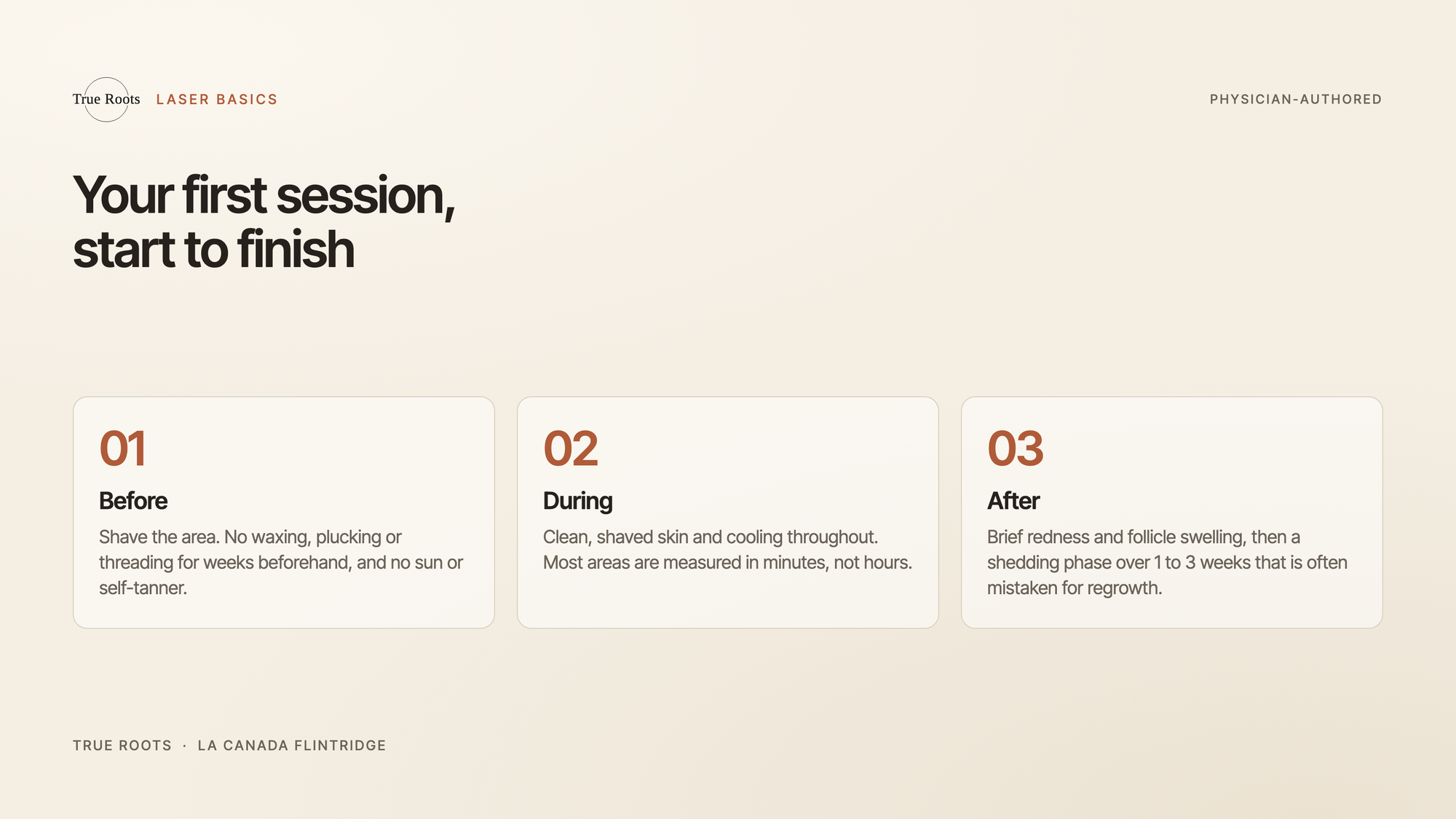
Shave the area the day before or the morning of, and do not wax, pluck, or thread for about four weeks beforehand, because the laser needs the follicle's pigmented target intact. The session itself is quick and cooled. Expect redness and small bumps for a few hours, then shedding over the next one to three weeks.
Nothing here is complicated, but the prep rules are not intuitive, and the ones people get wrong are the ones that cost them a session.
What should you do in the weeks before?
Stop removing hair by the root. Waxing, plucking, threading, and epilating all pull the hair out of the follicle. The laser targets the pigment in that hair. Remove it and there is nothing for the energy to find, so the session accomplishes very little. Give it about four weeks.
Keep shaving. Shaving cuts at the surface and leaves the follicle intact, which is exactly what you want. Depilatory creams are generally avoided in the days beforehand because they can leave skin irritated.
Stay out of the sun, and off the self-tanner. Tanned skin carries more epidermal melanin, which competes with the hair for the laser's energy and narrows the safe treatment window. Sunless tanner is worse in one respect: it adds surface pigment that has nothing to do with your actual skin type. Two weeks clear is a reasonable minimum, and daily sunscreen on the area helps.
Flag your medications and history. Some medications increase light sensitivity, and recent cosmetic treatments on the area can change the plan. This comes up at your consultation.
What do you do the day of?
Arrive with the area cleanly shaved and washed. Skip lotion, body oil, makeup, deodorant, and antiperspirant on anything being treated, since products on the surface interfere with contact and cooling.
Wear something loose and comfortable that gives easy access to the area and will not rub afterward.
Expect a short intake before the first session: a skin type assessment, a review of your hair and goals, and usually a test pulse or patch area to confirm settings before treating the whole region.
What does the session actually feel like?
Most people describe each pulse as a quick warm snap, roughly like a rubber band, over skin that is being cooled continuously. Coarse, dense hair registers more than fine hair does. The first session usually feels the most noticeable, because there is the most hair present.
Cooling is doing constant work in the background. Chilled air and contact cooling pull heat out of the surface while the follicle underneath still receives full energy, which is what keeps the session tolerable without numbing.
Timing depends on area size and the device. Small areas like the upper lip or underarms are a matter of minutes. Larger regions like a full back or full legs run longer, though a large spot size and a high repetition rate shorten them considerably. Inside Splendor X explains why coverage speed varies so much between machines.
Before and after, in one table
| When | Do | Do not |
|---|---|---|
| 4 weeks before | Shave as often as you like | Wax, pluck, thread, or epilate |
| 2 weeks before | Use sunscreen on the area daily | Tan, use tanning beds, or apply self-tanner |
| Day of | Arrive clean and freshly shaved | Wear lotion, oil, makeup, or deodorant on the area |
| First 24-48 hours after | Cool compresses, gentle moisturizer, loose clothing | Hot tubs, saunas, steam rooms, intense workouts |
| First week after | Sunscreen on treated skin every day | Retinoids, acids, or scrubs on the area |
| Weeks 1-3 after | Let the shedding happen, exfoliate gently if advised | Assume shedding hairs are regrowth |
What happens right after?
Redness is normal, and so is perifollicular edema: small raised bumps around each follicle that look a bit like goosebumps. That reaction is a sign the follicles absorbed energy.
For most people it settles within a few hours, sometimes up to a day. A cool compress and a plain moisturizer are usually all that is needed.
You can go back to your day immediately. There is no downtime in the meaningful sense, only a short list of things to avoid while the skin calms down.
Anything beyond mild redness and swelling, such as blistering, lasting pain, or crusting, is worth a call to the clinic rather than waiting it out.
What is the shedding phase, and why does it look like regrowth?
This is the part that confuses almost everyone.
Over roughly one to three weeks after a session, treated hairs push out of the follicle and emerge at the surface before falling away. They look, feel, and behave like new growth. They are not.
Gentle exfoliation during this window helps them clear and reduces the odds of ingrown hairs. Do not wax or pluck them. Shaving is fine.
Real regrowth is different: it comes from follicles that were resting rather than actively growing on the day you were treated, which is exactly why a course is spaced out. The mechanism is covered in how laser hair removal actually works.
How should you care for the skin afterward?
Sun protection first. Treated skin is more sensitive for a while, and unprotected sun exposure between sessions can affect both safety and results. Broad-spectrum sunscreen on exposed areas, daily.
Skip heat for 24 to 48 hours. Hot tubs, saunas, steam rooms, very hot showers, and hard workouts all raise skin temperature and add friction and sweat while the follicles are still reactive.
Pause the actives briefly. Retinoids, glycolic and salicylic acids, and physical scrubs go on hold on the treated area for a few days.
Loose clothing over the area for a day, especially on the bikini line, underarms, and anywhere clothing rubs.
How many sessions, how far apart, and then what?
Sessions are typically spaced 4 to 6 weeks apart, set by how quickly the body region cycles. Facial and underarm hair returns faster and is spaced more tightly. Legs, backs, and chests are usually spaced further apart.
Plan for a course rather than a number. Most areas take a series of sessions, and the total depends on hair color and coarseness, skin tone, area, and hormonal drivers. One published series in skin of color reported a mean of about 8.9 treatments with a range of 4 to 22, which is a fair illustration of how much individual variation exists.
After the course, some people are done and some come back once or twice a year for maintenance, particularly where hormones keep stimulating follicles. Coarse, dense body hair often needs a longer course, covered in laser hair removal for men.
True Roots Performance & Aesthetics is in La Canada Flintridge and treats patients from Pasadena, Glendale, and across greater Los Angeles. Sessions are performed on the Lumenis Splendor X by a licensed nurse practitioner who is physician-trained and Lumenis-certified. If you are driving in from the east side of the 2, see laser hair removal in Glendale.
This article is educational and not a substitute for personalized medical advice.